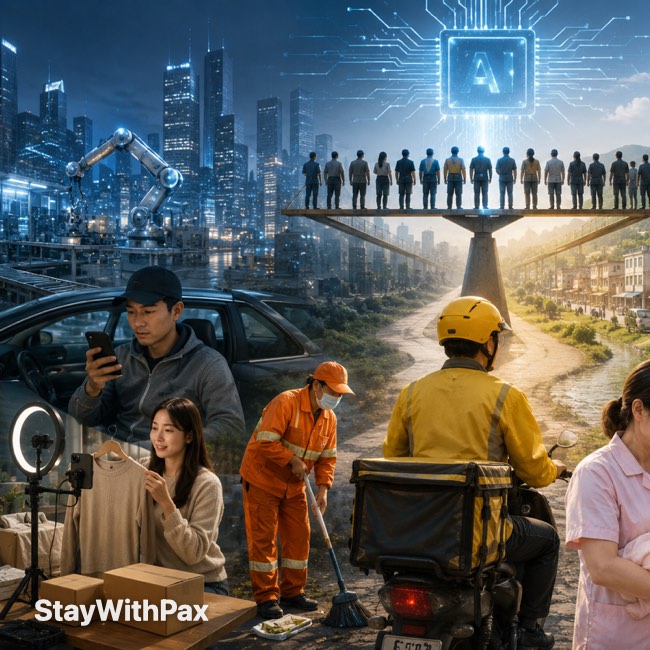
A recent employment study reported that China's flexible workforce has reached a very large scale and may continue growing. Flexible employment is no longer only a supplement to the labor market. It has become an important pillar.
This provides another angle on the AI dividend.
The previous question was: after AI improves efficiency, who receives the benefit? The flexible-employment data gives part of the answer. Some of the dividend may flow not into traditional full-time jobs, but into more fragmented, task-based, project-based, and platform-based forms of work.
Efficiency Does Not Automatically Become Better Jobs
AI lowers the cost of producing text, images, code, analysis, customer service, and many back-office tasks. That may create new income opportunities for people who can package their skills, serve multiple clients, and use tools to increase output.
But it can also weaken bargaining power for people whose work is easy to standardize and replace.
The difference is whether a worker can move closer to decision-making, customer trust, technical judgment, or workflow control.
Flexible Work Can Be Opportunity and Risk
Flexible work can provide income, autonomy, and access to projects that would not exist in traditional employment. AI can strengthen that by giving individuals more production capacity.
But flexible work can also mean unstable income, weak benefits, unclear responsibility, and limited career accumulation.
For companies, the challenge is similar. A flexible network can provide speed and specialization. It can also create quality-control and accountability problems if tasks are scattered without a clear owner.
What This Means for Suppliers and Buyers
In China sourcing, many services already rely on flexible networks: translators, inspectors, photographers, drivers, technicians, designers, and local coordinators. AI can improve documentation and coordination, but it does not remove the need for reliable people on the ground.
For overseas buyers, the key is not whether a supplier uses flexible labor. The key is whether the supplier has a system to manage it: standards, records, review, responsibility, and communication.
Practical Takeaway
AI will not simply replace people. It will change which people gain leverage. The winners are more likely to be those who combine tools with judgment, customer access, and accountable delivery.