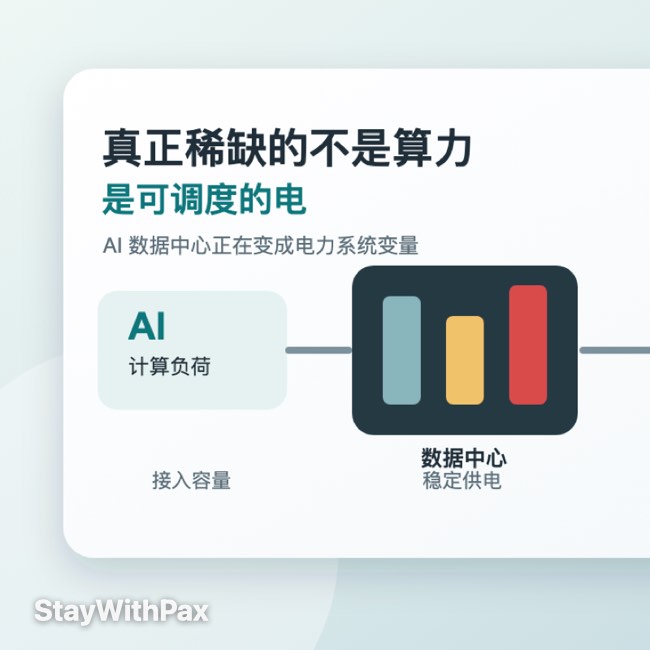
The next scarce resource in the AI industry is not only chips. It is not even electricity in the ordinary sense. It is electricity that is available at the right time, in the right location, connected stably, and dispatchable.
Several recent signals point in the same direction.
China released an action plan in May 2026 to promote the mutual empowerment of AI and energy. The policy direction is to improve clean-energy supply for AI computing infrastructure by 2030 and expand AI applications in the energy sector.
The North American Electric Reliability Corporation issued a Level 3 Alert in May 2026 about risks from computational loads connecting to the bulk power system. Reports noted that some large customer-initiated load reductions and oscillations may happen within seconds.
ICIS also used a useful phrase in its discussion of China's AI data-center energy supply: AI baseload premium. In other words, data centers need not only cheap electricity, but power arrangements that behave more like stable baseload.
Put together, these signals show a change: compute is no longer only a digital-industry issue. It is becoming a power-system planning issue.
Data Centers Are Not Just Large Customers
In the past, a utility could treat a data center mostly as a large customer. The customer needed electricity; the utility assessed capacity, connected lines, built substations, signed contracts, and collected bills.
AI data centers are different.
They are large and dense. They operate continuously. They require extremely stable supply. Their load behavior may also become more complex as computing tasks change.
That is why NERC's alert matters. The concern is not only growth in ordinary data-center demand. It is computational loads, including AI training, crypto mining, and traditional data centers.
The key issue is not only size, but behavior. Large load reductions or oscillations within seconds are a power-system problem.
The grid is not the internet. If the internet slows down, a page spins, a video drops resolution, or a request retries. In the grid, frequency, voltage, protection systems, and power balance operate in real time. Sudden large-load changes are not user-experience problems. They are system-stability problems.
That means data centers are changing identity. They used to be electricity customers. Now they are becoming variables inside the power system.
The Question Is Not Whether There Is Enough Electricity
A common AI-power question is: will there be enough electricity?
The deeper questions are more specific.
First, does the local grid have capacity? Total regional generation may look sufficient, but that does not mean a data-center project can connect immediately. Transmission lines, substations, distribution capacity, local load curves, and reserves all affect whether a project can land.
Second, can grid connection timing match construction timing? AI demand can change in months. Grid construction does not move like software iteration. Lines, substations, approvals, equipment, land, and interconnection all follow slower cycles.
Third, are power prices and supply conditions predictable? A data center is a heavy investment in servers, cooling, network, power facilities, land, and long-term contracts. If electricity prices fluctuate too much or supply terms are unstable, the business model becomes hard to calculate.
Fourth, does the power source satisfy low-carbon requirements? Large technology companies, multinational customers, and regulators care about emissions. A data center cannot only say it uses electricity. It must explain where the electricity comes from, whether it matches green-power commitments, and whether the claim can be audited.
In the AI era, valuable electricity is power that can be connected, used for the long term, priced predictably, explained in carbon terms, and integrated without destabilizing the grid.
Why China's Policy Emphasizes Coordination
One word in China's AI-energy policy is especially important: coordination.
The policy is not only about increasing clean-energy supply. It is about reliable energy supply for computing infrastructure, green and low-carbon transformation, and efficient economic coordination between computing and power.
This means compute cannot be planned alone. It has to be calculated together with generation, grid, load, market mechanisms, and dispatch.
Green power also cannot be understood only as a certificate issue. Solar depends on sunlight, wind on wind conditions, hydro on water flows. A data center cannot simply say it will train less when the wind is weak or pause inference when there is no sun.
It needs continuous, stable, predictable supply.
The real questions are: can renewable energy be absorbed? Can storage keep up? What stable power source provides backup? Can the grid move power from resource regions to load regions? Can large loads participate in demand response instead of only taking electricity from the system?
These are the deep-water questions where AI and energy meet.
What the AI Baseload Premium Signals
Baseload refers to the continuous underlying load or supply requirement in a power system. Premium means this quality becomes more valuable.
An AI baseload premium suggests that data centers need more than any kilowatt-hour. They need power that is stable, predictable, and closer to baseload characteristics. Such power becomes more valuable inside the system.
This also explains why annual green-power certificates are not enough by themselves.
If a data center's peak load does not match solar output, if night-time inference requires stable power, or if services must continue during extreme weather, the company needs more than a paper annual green ratio. It needs hourly and system-level matching.
There is no single solution. Different regions have different resources, grid structures, regulations, and customer needs. But the direction is clear. AI data centers will raise demand for stable power and raise the value of power-system coordination.
China's Opportunity and Pressure
China has advantages: a huge power system, strong renewable deployment, manufacturing capacity, ultra-high-voltage transmission, storage, coal-power flexibility retrofits, electricity-market reform, and extensive industrial-park and data-center planning experience.
This gives China an opportunity to calculate several things together: where computing should be placed, where power comes from, how renewable energy is absorbed, how storage is configured, how the grid expands, how parks are dispatched, and how electricity prices are designed.
The pressure is equally real.
Rapid renewable installation does not mean every kilowatt-hour is used well. Some regions still face absorption, transmission, peak-shaving, and load-matching problems.
If planned well, data centers can become high-quality loads that connect renewable energy, storage, and industrial demand. If planned badly, they can become new system pressure.
Projects may chase low prices and policy incentives without considering local grid capacity. Computing parks may concentrate without enough storage, backup power, peak regulation, or transmission. Actual load curves may not match green-power supply curves.
AI competition looks like compute competition on the surface. Underneath, it is power-system competition.
The real constraint is not simply whether electricity exists. It is whether that electricity can be connected, balanced, dispatched, and committed for the long term.
That is one of the most underestimated infrastructure issues of the AI era.