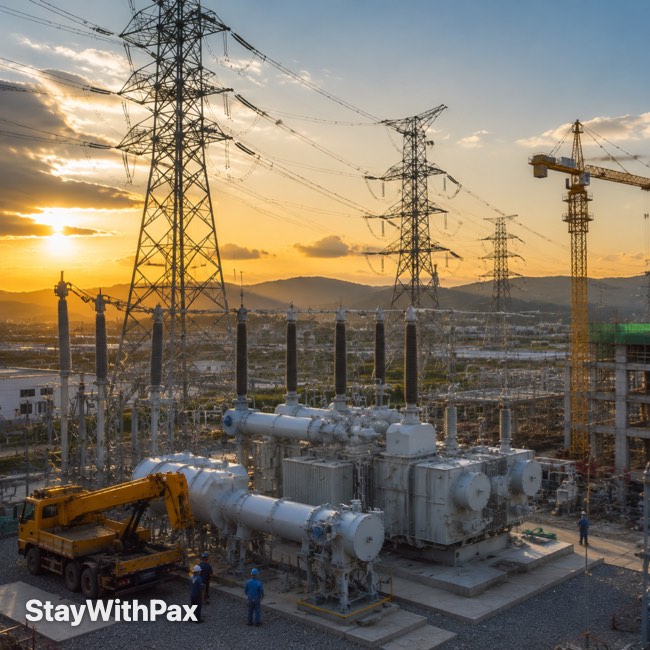
Two recent nuclear-power updates from Guangdong are more interesting when read together.
The first came from Huizhou Taipingling.
On July 4, Taipingling nuclear power unit 2 was connected to the grid. According to reporting carried by Bastille Post, this is the second unit at the Greater Bay Area's first Hualong One nuclear project to reach the grid-connection stage. Unit 1 entered commercial operation in April 2026. Unit 2 still needs to complete performance verification and is targeted for operation in the second half of 2026.
The second came from Lianjiang in Zhanjiang.
According to Autonocion's July 4 report, Lianjiang nuclear power unit 1 completed the lifting of its outer steel dome in June. The dome is about 41 meters in diameter and close to 1,000 tons in weight. After this milestone, the main civil construction phase has largely reached the enclosure stage, with equipment installation and internal systems work to follow. The target for power generation is 2028.
These two updates point to two different nuclear technology routes advancing at the same time.
One route is Hualong One.
It represents China's domestic third-generation nuclear technology system. The key words are local design, local engineering standards, and repeatable construction.
The other route is CAP1000.
It represents the localization and industrial absorption of Westinghouse's AP1000 technology. The original foreign technology has gradually become a Chinese production line that can be built, adapted, and repeated locally.
Together, the two routes show that China's nuclear industry is no longer built around one demonstration project or one technology identity. It is forming a broader capability structure: domestic R&D, technology absorption, local manufacturing, project organization, and repeat construction are moving together.
Taipingling: Hualong One Becomes a Production Rhythm
Hualong One is already familiar as China's domestic third-generation nuclear reactor technology. It is important not only because it is domestic, but because it can be built repeatedly and exported.
The most interesting part of Taipingling is the rhythm between unit 1 and unit 2.
Unit 1 entered commercial operation in April 2026. Unit 2 reached grid connection in July. That timing suggests the project is no longer a single-unit breakthrough. It is moving as a unit group.
When a nuclear reactor type begins to show stable construction and commissioning rhythm, nuclear power starts to look less like a one-off demonstration and more like a replicable industrial product.
Taipingling is planned as a six-unit Hualong One project. According to disclosed figures, each unit is expected to generate more than 9 billion kWh annually after commercial operation. The full six-unit project is expected to generate more than 55 billion kWh per year after completion.
That is the more important signal: a domestic reactor line is taking shape in one of China's most important load centers.
Lianjiang: CAP1000 Shows the Other Hand
Lianjiang is interesting because it is not Hualong One.
It is CAP1000.
If viewed through industrial history, Westinghouse originally sold AP1000 technology to China as a reactor design. Years later, China has not only built projects. It has formed a localized route.
Autonocion's report framed this as selling a recipe to a future competitor. That is media language, but the underlying point is not unreasonable.
In nuclear power, drawings are only the first step. The harder question is whether drawings can become engineering, and whether engineering can become repeated projects.
Lianjiang's schedule is worth watching. First concrete was poured in September 2023. The reactor pressure vessel was installed in February 2025. The outer dome was lifted in June 2026. The project targets power generation in 2028.
If that schedule is achieved, it would suggest something close to a five-year construction cycle for a large unit.
Reporting also described a passive containment cooling water-storage device integrated above the Lianjiang unit's dome. The core logic of passive safety is to rely less on active external drives such as pumps or emergency power, and more on physical properties such as gravity and natural circulation to maintain cooling under abnormal conditions.
That has long been one of the selling points of the AP1000 and CAP1000 route: make critical safety functions more passive and simpler where possible.
Cooling Design as Product Capability
Lianjiang has another notable feature.
The project includes a 218.7-meter seawater cooling tower, described in reporting as an ultra-large seawater cooling tower for nuclear power. The design is said to use seawater in a secondary circulation system, reducing reliance on the once-through seawater discharge path often associated with coastal nuclear plants.
That points to another layer of China's nuclear engineering evolution.
A nuclear plant must answer more than "can it generate power?" It must also answer "can it coexist with its surrounding environment?"
If Lianjiang's cooling route performs as designed, the important point is not only a "world first" label. It shows China trying to make environmental constraints part of the product and engineering capability, not an afterthought outside the plant.
Two Routes, One Capability Structure
Taipingling and Lianjiang together form a clearer picture.
Taipingling shows Hualong One, China's domestic route, landing steadily in the South China load center.
Lianjiang shows CAP1000, the localized AP1000-derived route, moving through another large-unit construction path.
It is difficult to say that one route is more important than the other.
One answers the question: does China have its own nuclear technology system?
The other answers the question: can China absorb an advanced international route and turn it into its own industrial capability?
Many countries do not fail in energy transition because they have no ideas. They fail because project execution is weak.
That is why these two Guangdong updates matter. They suggest that China's nuclear power sector has entered a more system-level stage. Different technology routes are moving forward in the same province and in the same time window.
For an industry where construction rhythm, supply chains, safety systems, local acceptance, and environmental design all matter, that is more important than any single headline.
Sources
1. Bastille Post, https://www.bastillepost.com/global/article/5986099-unit-2-of-taipingling-nuclear-power-project-connects-with-grid-for-electricity-generation 2. Autonocion, https://www.autonocion.com/us/china-conical-reactor/