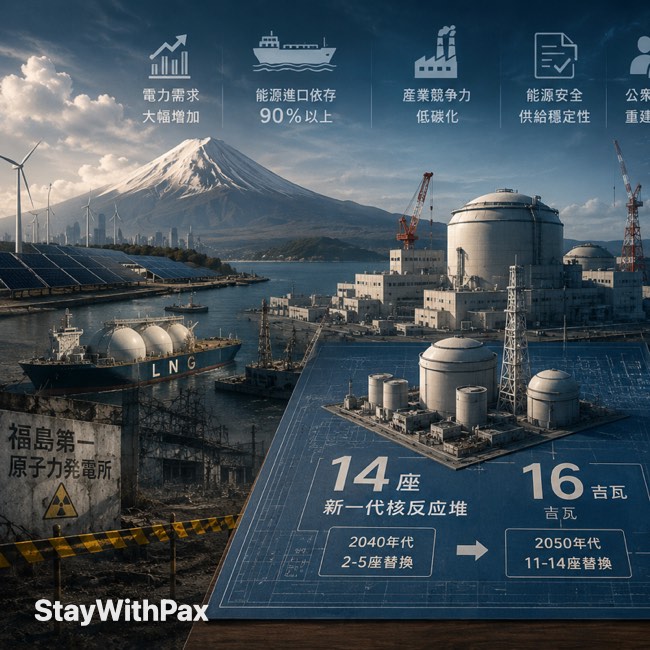
On June 5, 2026, Japan's Ministry of Economy, Trade and Industry presented a draft plan to its nuclear policy working group. The proposal would gradually replace aging nuclear reactors with next-generation units by the 2050s, with up to 14 reactors and about 16 GW of new capacity.
This is the first time since Fukushima that Japan has put a concrete number on reactor replacement or rebuilding. It is not simply about restarting old reactors. It is about what comes after old units retire.
Why Now?
The most visible trigger is AI.
Wood Mackenzie has projected that Japan's data-center electricity demand could nearly triple by 2034, driven by investment from Oracle, Google, Microsoft, and domestic AI infrastructure projects. Data centers alone may account for a large share of Japan's electricity-demand growth.
But AI is not the only reason.
Japan imports more than 90% of its primary energy. LNG, coal, and oil have long been structural constraints on energy security. Any shock in international energy markets can move directly into electricity prices, corporate costs, and supply risk.
At the same time, the industries Japan wants to support, including AI, data centers, semiconductor fabs, and battery manufacturing, are all power-hungry. They need stable electricity around the clock. They also increasingly need low-carbon power to meet technology companies' ESG and carbon commitments.
Continuing to rely heavily on LNG and coal raises both cost and emissions pressure. Betting entirely on renewables runs into Japan's limited land and grid-balancing constraints. Returning to nuclear power means confronting the public-trust problem left by Fukushima.
14 Reactors, 16 GW, Two Stages
METI's plan has two stages. In the 2040s, Japan would replace two to five reactors. By the 2050s, the total could reach 11 to 14 reactors, with around 16 GW of capacity. That is roughly close to half of Japan's currently operable nuclear capacity.
The timing pressure is real. Many reactors stopped after Fukushima have gradually restarted, but the fleet is aging and will eventually approach operating-life limits. Life extension can help, but it cannot carry the system indefinitely.
Japan's Seventh Strategic Energy Plan calls for nuclear power to reach around 20% of electricity generation by fiscal 2040. Current reality is closer to 8% to 10%. Without new units, the nuclear share may fall as old reactors retire.
So the real meaning of the draft is this: Japan is no longer satisfied with gradually restarting qualified old units. It is formally reopening the harder question of whether Japan should build nuclear reactors again after Fukushima.
New Reactors Are Not a Simple Return to Old Nuclear
Japan does not plan to copy old reactors directly.
The innovation directions include advanced light-water reactors, small light-water reactors, fast reactors, high-temperature gas-cooled reactors, and fusion-related technologies. The most realistic near-term candidate is Mitsubishi Heavy Industries' SRZ-1200, a roughly 1,200 MW advanced pressurized-water reactor.
Its design emphasizes passive safety systems: the ability to remove residual core heat even without external power support, reducing risk under extreme disaster scenarios. That design logic carries the imprint of Fukushima.
High-temperature gas-cooled reactors point to an even broader role. They can produce electricity and high-temperature heat for industrial uses such as hydrogen production, steel, or chemicals. For a manufacturing country like Japan, the hardest part of energy transition is not only replacing coal power with solar panels. It is also replacing high-temperature industrial heat that electricity alone cannot easily serve.
If nuclear energy can extend from power generation into industrial heat, its role changes. It becomes not only baseload electricity, but industrial decarbonization infrastructure. That is the deeper reason Japan is discussing nuclear again. It is not nostalgia. It is industrial competition.
The Problems Are Serious
Cost is the first problem. If one large replacement reactor costs around USD 7 billion, 14 reactors would approach USD 100 billion before overruns. And no overrun is an optimistic assumption in nuclear construction. Flamanville 3 in France and Hinkley Point C in the UK are reminders that nuclear projects can suffer both cost and schedule overruns.
The cost of nuclear power is not only levelized electricity cost. It includes financing cost, construction time, regulatory uncertainty, and long local political negotiation.
Talent and supply chain are another problem. Long pauses in new nuclear construction weaken engineering capacity. Nuclear-grade design, manufacturing, welding, construction management, and quality systems require long accumulation. Supply chains shrink, senior engineers retire, younger engineers move to other fields, and companies allocate resources elsewhere.
Japan is not only trying to build reactors. It may need to rebuild an entire nuclear-engineering capability.
Trust may be harder than cost and technology combined. In January 2026, Japan's Nuclear Regulation Authority paused safety review for units 3 and 4 at the Hamaoka nuclear plant because seismic-risk assessment data and methods were questioned. Hamaoka is located in one of Japan's most sensitive earthquake-risk areas. A technical review issue quickly became a public-trust issue.
After Fukushima, Japan lost not only generation capacity. It lost public trust in operators, regulators, and government decision-making. Technology can be upgraded and rules can be revised, but trust recovers much more slowly than infrastructure is built.
The Unfinished Waste Question
The longer-term question is high-level radioactive waste.
A reactor may operate for decades, but spent fuel and high-level waste involve time scales of hundreds or thousands of years. Japan still has not finalized a permanent geological disposal site for high-level waste.
This is not unique to Japan. But Japan's small land area, frequent earthquakes, and strong local sensitivity toward nuclear facilities make the politics especially difficult.
Finland's Onkalo repository is often cited as a serious long-term model: spent fuel is sealed and placed deep in stable bedrock. Japan has searched for years, but the political and engineering loop remains incomplete.
Every new reactor adds future spent fuel that must be managed. A long-term plan for 16 GW of new capacity without a parallel waste solution effectively leaves part of the cost to the future. This is why nuclear power is not only a generation-technology choice. It is an intergenerational contract.
Nuclear and Renewables Are Not Always Simple Complements
A nuclear revival could also change renewable-energy investment logic.
Japan has expanded solar power over the past decade, but grid absorption and curtailment have already become issues. If replacement nuclear capacity enters the system as stable baseload while demand, storage, and flexibility do not grow fast enough, nuclear and renewables may compete in some time periods.
This does not mean nuclear necessarily blocks renewables. The real question is not nuclear versus renewables. It is how to operate a system with high nuclear share, high renewable share, low fossil-fuel share, and large AI data-center demand.
AI data centers match nuclear power in one obvious way: they need large, stable, low-carbon electricity. But renewables plus storage and flexible dispatch can also serve part of the need, with higher system complexity.
Nuclear gives a direct answer. Energy transition needs more than directness. It also needs cost control, flexibility, risk diversification, and social acceptance.
A Political Threshold Has Been Crossed
The June 5 draft crosses a political threshold.
Before this, Japan's nuclear revival was mostly expressed as direction: raise nuclear share, restart qualified units, develop next-generation nuclear technology. Those statements were important, but they did not create a measurable construction scale.
Now the numbers 14 reactors and 16 GW make the target trackable. In the future, anyone can ask: how many reactors were replaced in the 2040s? Did nuclear approach 20%? Did costs overrun? Did local communities accept the projects? Did waste disposal move forward? Did regulatory trust recover?
Not Only Japan's Problem
When the country that experienced Fukushima starts planning new reactors again, the signal is complex.
On one hand, nuclear power is regaining policy space under the combined pressure of carbon neutrality and AI compute expansion. The US, UK, Korea, France, and many emerging economies are also revisiting nuclear power. Stable, low-carbon, high-capacity-factor electricity is being repriced in the AI era.
On the other hand, Japan's case is a warning. Nuclear revival is not a slogan. It requires money, time, engineering capacity, regulatory capability, local consent, and public trust.
Japan's real question is not simply whether it needs nuclear power. It is whether a country deeply reshaped by a nuclear accident can rebuild a system that the public will trust.
That may be harder than building the reactors themselves.