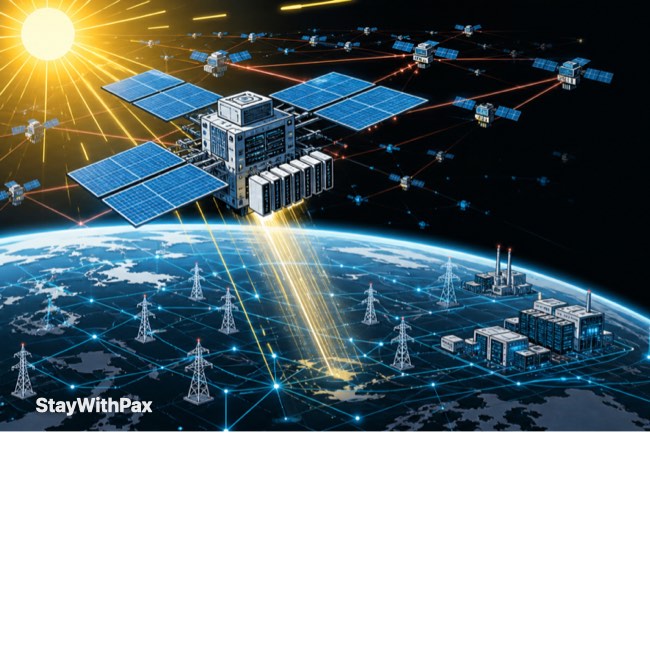
SpaceX's idea of building space-based data centers sounds like science fiction.
One million satellites. A long-term target linked to 100 terawatts of compute. These numbers do not sound like a normal business plan.
But if we dismiss it as another futuristic Elon Musk story, we may miss the more important point. SpaceX is not only talking about sending servers into orbit. It is responding to a real problem on Earth: power, land, cooling, and grid connection are becoming increasingly scarce for AI infrastructure.
It Starts With an FCC Filing
In early 2026, SpaceX filed documents with the US Federal Communications Commission for an orbital data-center system that could involve up to one million satellites. The idea is that satellites would use solar power, connect through inter-satellite laser links, and perform AI inference or machine-learning tasks in orbit.
Later, SpaceX IPO materials reportedly included an even larger long-term compute target. The exact number should be treated as an incentive target, not an engineering schedule. But the intention is clear: SpaceX wants to participate in the upstream energy competition behind AI infrastructure.
AI Companies Are No Longer Only Competing for GPUs
For the past two years, the technology industry focused on GPU shortages. But the real anxiety is changing.
Microsoft, Google, Amazon, Meta, and others are signing long-term power agreements, exploring nuclear power, investing in new generation, and searching for data-center locations with faster grid access.
The reason is simple. Chips can be bought. Servers can be installed. But grids cannot be expanded instantly.
A large AI data center needs land, substations, transmission lines, cooling systems, and hundreds of megawatts of continuous power. If one part is late, purchased chips may sit idle.
Orbit Has Sunlight, but Not Free Electricity
The attraction of orbital data centers is solar energy. Satellites in suitable orbits may receive longer sunlight exposure than ground solar panels. They do not need to buy large land parcels or wait for a substation queue.
SpaceX also owns key pieces: reusable rockets, satellite manufacturing, laser communications, and Starlink operating experience.
On paper, launching solar panels, AI chips, and cooling systems into orbit is a coherent logic.
But space does not remove physics.
Cooling Is the First Barrier
Space is cold, but there is no air. Server heat cannot be removed by fans or cooling towers. It must mainly be radiated away. The more compute power, the larger and heavier the radiators.
More weight means higher launch cost. Cooling may gradually eat away any advantage orbital compute has over ground data centers.
Data Transfer Is the Second Barrier
If raw data must be uploaded from Earth and results continuously sent back, communication links may become a bottleneck even before electricity does.
The earliest practical workloads may not be everyday search or office chatbots. A more realistic use case is processing data already generated in space, such as remote-sensing images, satellite communications, and navigation data.
Maintenance and Upgrade Are the Third Barrier
A broken ground server can be replaced. A satellite with radiation damage, cooling failure, or communication issues is much harder to repair.
AI chips may also become outdated in a few years. If the hardware still works but is no longer competitive, the economics become difficult.
The Space Solution Exposes the Earth Problem
The most interesting meaning of SpaceX's idea is the reverse signal it sends.
If electricity on Earth were cheap, stable, easy to connect, and supported by enough land and cooling, launching data centers into orbit would almost certainly be too expensive.
Orbital compute is being discussed because ground infrastructure is not expanding fast enough.
Nuclear restarts, grid expansion, and orbital data centers look like different topics. Underneath, they all ask the same question: how much electricity will AI need, where will it come from, and when can it be connected?
Practical Takeaway
SpaceX's orbital data-center plan may not become near-term reality. But the question it raises is real.
AI competition is moving from models and chips toward energy, cooling, communications, and infrastructure integration. Whoever can organize power, compute, heat removal, and connectivity into a reliable system will have a deeper advantage.