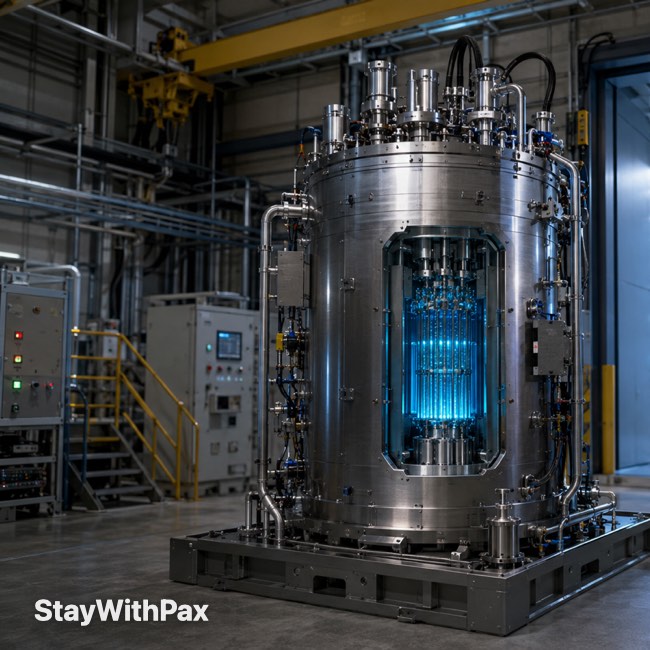
Deployable Energy's Unity microreactor has achieved first criticality.
That sentence sounds technical, but the larger signal is simple: the United States is trying to move nuclear energy away from a decade-long mega-project model and toward something closer to standardized industrial equipment.
If that path works, the implications extend beyond the nuclear sector. AI data centers, remote mines, defense bases, offshore platforms, critical infrastructure, and backup-power users may all reconsider what a local power source can look like.
What Unity Is, and What It Is Not
Unity is not a large nuclear power station.
When most people hear "nuclear power," they imagine a multi-gigawatt plant, long construction cycles, complex licensing, and a major grid connection.
Unity is different. It is a 1 MWe-class microreactor.
That size matters. It is many orders of magnitude smaller than a traditional large reactor. It is not designed to replace a central nuclear power station. It is aimed at a different gap: distributed loads, weak grids, off-grid sites, and users that value power resilience and autonomy.
First criticality also does not mean commercial electricity generation.
Criticality means the reactor has achieved a controlled, self-sustaining chain reaction. It does not mean the system is ready for stable power generation, has completed full safety verification, or has proved a commercial business model.
A useful analogy is engine ignition. It is a necessary milestone, but it is still far from long-duration operation, full output, regulatory deployment, and commercial scale.
Why the Timing Matters
This milestone sits inside a larger US government push.
On May 29, 2025, an executive order published in the Federal Register directed the Department of Energy to enable at least three advanced reactors to reach criticality by July 4, 2026.
That deadline was not random. July 4, 2026 is US Independence Day and the 250th anniversary period of the country. This was not an ordinary project KPI. It was a national timing signal.
The result: three different advanced reactors reached criticality within roughly one month.
Antares' Mark-0 reached criticality at Idaho National Laboratory on June 4, 2026. Valar Atomics' Ward 250 reached criticality at the Utah San Rafael Energy Lab on June 18, 2026. Deployable Energy's Unity followed on June 30, 2026.
The message is clear. The United States does not only want to talk about nuclear energy. It wants to compress the early demonstration timeline.
What Unity Actually Proved
According to POWER Magazine and Deployable Energy's own announcement, Unity completed zero-power criticality at Idaho National Laboratory.
That means the chain reaction could be sustained in a controlled state. It does not mean the system has moved into full-power operation.
So Unity has proved an early physical and engineering path, not a commercial endpoint.
Still, it matters because Unity appears to be the first completed case under the DOE's Nuclear Energy Launch Pad pathway. In that sense, it is not only a reactor milestone. It is also a test of a new acceleration channel for advanced nuclear energy.
Unity is partly a pathfinder for the projects that follow.
Why 150 Days Is Unusual
Deployable Energy and POWER described a roughly 150-day path from project kick-off to reactor and fuel delivery, preparation, and criticality readiness.
For anyone familiar with nuclear engineering, that is highly unusual.
Site preparation, civil works, nuclear-grade equipment, fuel supply, safety analysis, authorization, commissioning, and operational readiness normally move slowly. Any one of these items can consume a long schedule.
Unity compressed the timeline by avoiding several old constraints.
First, it avoided new infrastructure. Instead of building a separate new facility for the test, Unity used existing space at Idaho National Laboratory's North Radiography Station. Reports described the unit as small enough to be moved through ordinary doorways.
Much of the time in traditional nuclear projects is consumed by surrounding infrastructure and institutional process. Unity sidestepped part of that burden for the demonstration stage.
Second, Unity did not start with the most exotic possible route.
Its public design direction is water-moderated and gas-cooled, using 4.95% enriched LEU uranium dioxide fuel, with helium as the primary coolant.
That is practical. One of the main problems in advanced nuclear energy is not whether a concept sounds impressive. It is whether the design can actually be built, fueled, licensed, and operated.
Unity's approach appears to use materials and fuel that are easier to obtain, prove the first step, and leave full power generation and commercial deployment for later phases.
Why Call It a Nuclear Battery?
Deployable Energy does not market Unity as a small nuclear power plant. It calls it the Unity Nuclear Battery.
That language matters.
Traditional nuclear power is project-based. A plant requires financing, siting, construction, licensing, installation, training, grid integration, and long operating commitments.
A "nuclear battery" suggests a different commercial idea: make nuclear energy more standardized, more factory-assembled, more transportable, and easier to deploy on site. Ideally, refueling, return, maintenance, and decommissioning also become standardized services.
In other words, the goal is to pull nuclear power from a project model toward a product model.
Unity is not only trying to be a smaller reactor. It is testing whether nuclear energy can move from "large project" to "industrial equipment."
If that logic works, the first customers may not be ordinary central-grid utilities. They may be remote mines, defense sites, offshore facilities, data-center campuses, or critical-infrastructure operators that need resilient power and can pay for it.
The DOE Fast Lane Is Part of the Product
Unity's 150-day timeline is not only an engineering story. It is also an institutional story.
Unity moved through a DOE authorization pathway inside a national laboratory rather than a full commercial Nuclear Regulatory Commission licensing process from day one.
If a new reactor had to begin under the strictest commercial pathway immediately, this timeline would be almost impossible.
The Nuclear Energy Launch Pad is essentially a fast lane for early physical validation. It separates early criticality testing from the full commercial deployment process, uses DOE sites and facilities to run the earliest validation step, and then brings data and experience into more complete licensing pathways later.
POWER reported that NRC staff observed the DOE authorization process. That suggests the DOE path is not simply an attempt to bypass the NRC. It is more like an accelerator for advanced reactor validation.
If this pathway matures, it could change how quickly advanced reactor concepts move from paper to physical systems.
That does not mean commercial nuclear batteries are solved. It means the first bottleneck has been challenged.
Sources
1. [POWER Magazine: Deployable Energy's Unity Nuclear Reactor Achieves Criticality at INL, Third Under DOE Nuclear Push](https://www.powermag.com/deployable-energys-unity-nuclear-reactor-achieves-criticality-at-inl-third-under-doe-nuclear-push/) 2. [Deployable Energy: Deployable Energy Announces Unity Demonstration Reactor Achieves Criticality at Idaho National Laboratory](https://www.deployable.energy/post/deployable-energy-announces-unity-demonstration-reactor-achieves-criticality-at-idaho-national-labor) 3. [NRIC: Nuclear Energy Launch Pad at Idaho National Laboratory](https://nric.inl.gov/nuclear-energy-launch-pad-at-idaho-national-laboratory/) 4. [Federal Register: Reforming Nuclear Reactor Testing at the Department of Energy](https://www.federalregister.gov/documents/2025/05/29/2025-09799/reforming-nuclear-reactor-testing-at-the-department-of-energy) 5. [POWER Magazine: Antares Mark-0 Becomes First Advanced Nuclear Reactor to Achieve Criticality Under DOE Pilot Program](https://www.powermag.com/antares-mark-0-becomes-first-advanced-nuclear-reactor-to-achieve-criticality-under-doe-pilot-program/) 6. [POWER Magazine: Valar Atomic's Ward 250 Becomes Second Reactor to Go Critical Under DOE Pilot Program](https://www.powermag.com/valar-atomics-ward-250-becomes-second-reactor-to-go-critical-under-doe-pilot-program/)