I increasingly feel that many job titles inside companies are losing precision.
Marketing, product, engineering, finance, and operations will still exist. Companies still need reports, budgets, reporting lines, and payroll. But if you look closely at how real work gets done, work no longer follows department boundaries as neatly as before.
A product manager may write prototypes, run interviews, build demos, and use AI to draft copy. A content lead may select topics, write, edit videos, run private traffic, and build automation. An engineer may not only write code, but carry a feature from idea to launch and monitoring. A founder may talk to customers today, revise a contract tomorrow, review cash flow the next day, and then judge whether a new AI tool is useful or just social-media noise.
This sounds like everyone is becoming busier. A more accurate description is that roles are being reshuffled.
In the past, companies defined people by function: marketing, R&D, finance, operations. In the future, more people will be defined by capability structure:
- Can you get things made?
- Can you keep things from breaking?
- Can you make others willing to work with you?
- Can you make decisions under pressure and carry the consequences?
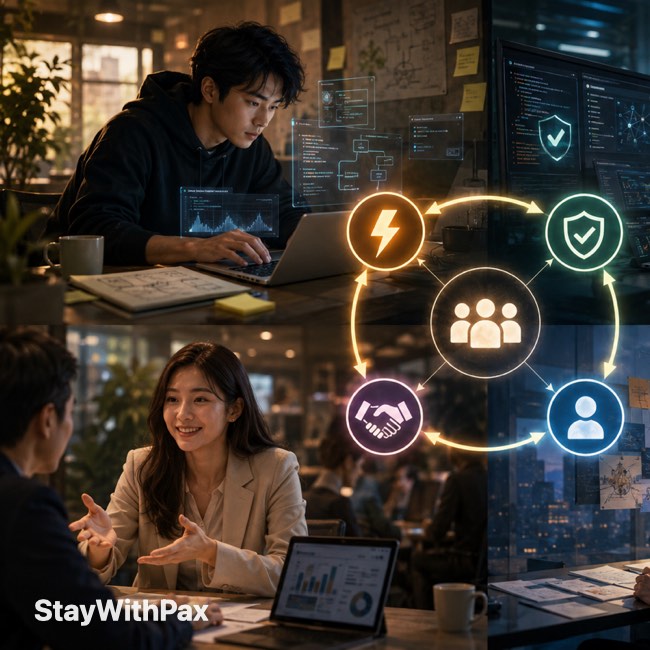
After thinking about this for a while, I believe future companies may become especially dependent on four types of people: high-output producers, safety gatekeepers, trust builders, and mature decision-makers.
1. High-Output Producers
The first type is the person who can produce at much higher speed.
This is not just a metaphor. In the past, the difference between two writers might be one article per day versus one article every three days. Now someone who knows how to use AI for topic breakdown, research organization, first-pass screening, and revision can finish the early work that once required a small team.
The same is true in software. A person who understands both the business and tools such as Claude Code can build a prototype, add tests, write documentation, and deploy much faster than before.
This is the direct impact of AI. It does not strengthen everyone equally. It gives enormous leverage to people who already know how to define problems, express requirements, and judge output quality.
The real change is not that one job disappears. It is that the best people inside the same job category become small production systems, while others continue working at the old speed.
The key skill is not familiarity with one tool. Tools change. The important skill is the ability to turn a vague goal into a sequence of executable actions: what should be judged by a human, what can be delegated to AI, when a 60-point prototype is enough, and when a 90-point delivery must be pushed hard.
A high-output producer is not just fast with hands. This person builds a production line.
2. Safety Gatekeepers
When producers become faster, companies become excited. Work that used to take a month may show results in a week.
But speed has a cost. The faster things are produced, the faster mistakes spread. Faster launches expose vulnerabilities faster. Faster content production also spreads factual errors and compliance risk faster.
Does an AI-generated contract draft contain the right liability boundary? Can it be signed? Who is responsible if something goes wrong?
Does AI-generated code contain permission gaps, missing logs, unsafe dependencies, or data exposure?
Speed does not automatically make these things better.
Safety here does not only mean cybersecurity. It also means legal compliance, financial control, brand risk, process stability, and even organizational psychological safety.
A good gatekeeper is like a braking system, but the brake exists so the car can move faster, not so it stops forever.
Many companies used to treat legal, audit, architecture, and risk-control roles as obstacles. Business wanted speed; safety said no. The organization became tense.
The best future gatekeepers will not only say no. They will understand why the business needs speed, know where speed becomes dangerous, and design rules inside fast-changing workflows. They may come from security, architecture, tech lead, legal, or risk roles, but not everyone in those roles can transform.
The future gatekeeper can look at a new workflow and quickly identify where permissions are needed, where audit logs must exist, what customer data cannot be sent to an external model, and which automation must still have human review.
This person understands both creation and constraint.
3. Trust Builders
The third type is harder to name. I call them trust builders.
This is not only about appearance or charm, although first impressions are real. More importantly, it is about doing things cleanly, communicating clearly, and handling relationships in a way that makes others willing to cooperate.
This ability will become more valuable in the AI era, not less.
As tools become cheaper and information gaps shrink, transactions return to people:
- Why does a customer choose you?
- Why does an investor believe you are not just telling a story?
- Why does talent join your team?
- When a misunderstanding happens, why is the other side willing to listen first?
AI can help write a better email, but it cannot replace your ability to understand what the other person is really worried about. AI can create a polished pitch deck, but it cannot build trust in a difficult twenty-minute conversation.
Many companies misunderstand sales, BD, PR, and customer success roles, thinking they are only about talking well. Strong trust builders reduce cooperation friction. They help strangers move into a workable relationship faster. They make customers feel understood and teams feel that there is a way forward.
When AI makes emails, slides, and business plans look similarly polished, what remains visible is the person: whether you are sincere, measured, reliable under pressure, and able to win business without selling out the delivery team.
4. Mature Decision-Makers
The fourth type is the mature person: the person who presses the button.
Every company eventually needs someone to decide. Not endless meetings, not endless co-creation, but a clear decision when information is incomplete, time is short, and every side has a point.
Maturity is not age or title. It is the ability to carry uncertainty.
A mature person knows there is no perfect answer, but still chooses. They know choosing A means giving up B. They know the decision may be wrong, but they think in advance about how to repair it.
This ability often grows out of uncomfortable experience: near-broken cash flow, a key customer suddenly changing direction, two important team members refusing to work together, or a project failing in public.
AI will produce more information, more options, and more seemingly reasonable paths. The company will not lack options. It will lack judgment.
A mature person compresses many plausible choices into one decision that can be executed today. This person is not necessarily the smartest person in the room. They are the person who turns intelligence into responsibility.
How Organizations May Rebuild Around These Capabilities
Departments will still exist, but they may become more like financial and management shells. Real execution will depend on the combination of these four capabilities.
Producers make things. Gatekeepers prevent the system from breaking. Trust builders move resources and relationships. Mature decision-makers choose at critical moments.
A small team with all four capabilities can move very fast. A producer builds the prototype. A gatekeeper checks risk at the same time. A trust builder takes it to customers for feedback. A mature decision-maker decides whether to continue, pause, or cut it. Then the next cycle begins.
This is faster than the old linear process where market demand becomes a product document, then engineering queues it, then testing accepts it.
AI is important in this system, but not as omnipotent as some people imagine. AI gives the strongest leverage to producers. Gatekeepers can use AI to review code, contracts, and anomalies, but the final risk judgment is still human. Trust builders can use AI to prepare materials and simulate customer questions, but real trust is not built by a model. Mature decision-makers can use AI to analyze options, but the final responsibility cannot be outsourced.
The stronger AI becomes, the more production can be automated. For exactly that reason, safety, trust, and responsibility become more visible.
What This Means for Individuals
If your work is content, product, design, or code, you probably need to become a high-output producer first. Do not only learn prompts. Build your own production system: how information enters, how tasks are broken down, how models participate, and how results are checked.
If you are naturally cautious and good at seeing risks others miss, you can grow into a gatekeeper. But do not rely on conservatism alone. Understand business speed and embed control into the process instead of shouting from outside the process.
If you are good at communication and making others comfortable, do not underestimate that ability. But do not reduce it to social smoothness. Future trust builders must understand the business and know what they can and cannot promise.
If you already carry projects, teams, or cash flow, train maturity. There is no standard course for it. Start with small decisions: decide within a tolerable risk range, review the result, and admit the cost.
The future career divide is not only whether you can use AI. The deeper divide is whether you know which of your abilities can be amplified: production, safety judgment, trust, or responsibility.