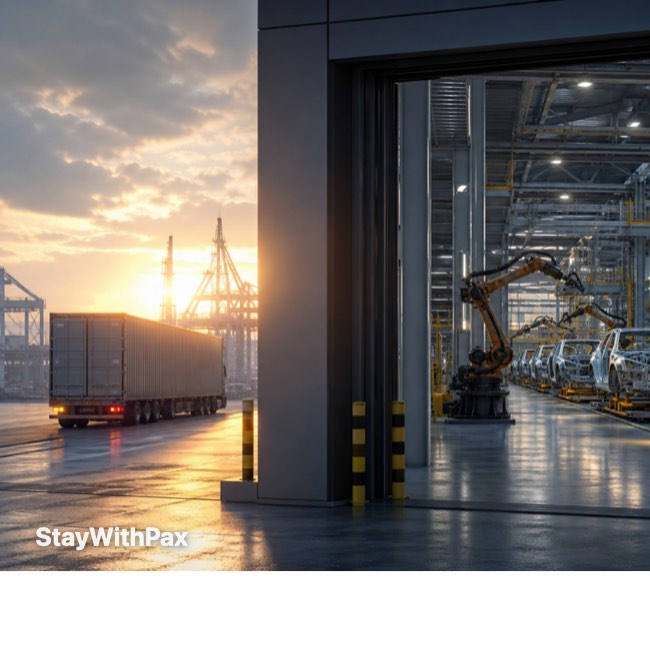
Chinese automakers are no longer marginal players in Europe.
Recent reporting on Chinese electric vehicles in Europe shows the shift clearly. In 2025, China remained the EU's largest source of imported cars, with imports rising more than 30% year on year and exceeding one million units for the first time. SAIC and BYD have entered the EU sales rankings in a visible way. In the first four months of 2026, SAIC and BYD reached roughly 2% and 1.9% EU market share respectively, surpassing some Japanese brands with much longer histories in Europe.
This is no longer a small experiment. Chinese automakers are entering the home field of the European auto industry.
Because of that, Europe is changing its expectations. In the past, the central question was whether Chinese cars could sell: were they affordable, well equipped, technically strong, and supported by distribution channels?
Now another question sits on top of that: are you only here to sell cars, or are you prepared to become part of Europe's local industrial system?
Europe Is Still Worth Entering, but It Is No Longer Easy
China, Europe, and the US are the world's three major electric-vehicle markets. China remains the largest EV market, Europe continues to grow, and the US has become more uncertain because of policy changes.
For Chinese automakers, Europe is still one of the most important overseas markets. It has scale, purchasing power, electrification pressure, and a mature car culture. Compared with the US, it is complicated but still relatively open.
That is why BYD, Xpeng, SAIC, Chery, Leapmotor, GAC, Dongfeng, and others have all increased their European efforts.
But European openness is not unconditional.
The EU's anti-subsidy tariffs on China-made battery electric vehicles did not close the door, but they changed the playbook. One immediate result is that plug-in hybrids and even combustion or hybrid product combinations became more important.
BYD initially pushed battery-electric models in Europe. After additional tariffs squeezed BEV margins, it quickly introduced the Seal U plug-in hybrid. According to reporting, the model became a leading plug-in hybrid in Europe, with sales exceeding 70,000 units. Its German starting price was around EUR 39,900, below major rivals such as the Volkswagen Tiguan PHEV.
SAIC and Chery also did not rely only on pure EVs. They brought a mix of new-energy and fuel or hybrid products.
This shows that Chinese automakers understand Europe cannot be approached by simply copying the China playbook. Pure EVs may have long-term potential, but the near-term volume may come from product combinations that fit local consumers and reduce some policy cost.
Tariffs Are Only the First Gate
It is tempting to say: if tariffs are the problem, build factories in Europe.
The reality is more complex.
Europe is not only raising import costs. It is redefining market access through public procurement, subsidies, low-carbon standards, local manufacturing, and foreign-investment review.
The proposed Industrial Accelerator Act points in this direction. For electric vehicles, plug-in hybrids, and fuel-cell vehicles to enter certain public procurement or support schemes, future rules may require EU assembly and a certain proportion of EU-origin components. Legal interpretations of the proposal suggest that, excluding batteries, a high share of vehicle component value may need to come from the EU.
That means local assembly alone may not be enough.
Europe wants to know whether a company brings local employees, local sourcing, local R&D, technology and knowledge transfer, and real value for the local industrial chain.
Foreign-investment screening may also become more relevant in strategic areas such as batteries and electric vehicles, especially where a third country already has a large share of global manufacturing capacity. Because China is so strong in batteries and EVs, Chinese projects may face additional scrutiny.
A European factory is therefore not an easy ticket. It may be linked to tariffs, subsidies, procurement eligibility, local employment, regulatory review, local-content ratios, and carbon records.
Four Ways Chinese Automakers Are Entering European Production
Chinese automakers are using several approaches.
The first is building their own factories. BYD's wholly owned plant in Hungary is a typical example. The advantage is control: production process, quality system, supplier relationship, and long-term localization stay in the company's hands. The disadvantage is high capital expenditure, long construction cycles, and policy uncertainty.
The second is taking over or reactivating existing European factories. Chery moved early through a joint venture with Spain's EV Motors to restart a former Nissan plant in Barcelona. Local authorities saw the project as a way to restore around 2,000 jobs and fill the industrial gap left by Nissan's closure.
This matters. If a Chinese automaker can absorb idle European capacity, employment pressure, and supplier-chain gaps, it is not only an outside competitor. It can become part of a local solution.
The third route is contract manufacturing. Xpeng and GAC Aion have used lighter-asset production paths through partners such as Magna. Magna understands European regulations and has existing manufacturing capability, allowing Chinese brands to localize more quickly and with lower upfront cost.
This path suits companies still testing the market but needing to reduce tariff and compliance pressure.
The fourth route is joint ventures or capacity partnerships with European automakers. Leapmotor's cooperation with Stellantis is one of the most important models to watch. Stellantis invested in Leapmotor, and the two sides created Leapmotor International for overseas sales and production. Leapmotor gained access to channels, while Stellantis gained more affordable EV products and better use of its European capacity.
Production cooperation is also advancing. Leapmotor's B10 is planned for production at Stellantis's Zaragoza plant in Spain. Dongfeng and Stellantis have also discussed a European joint venture involving sales, distribution, manufacturing, purchasing, and engineering activities for Voyah in parts of Europe.
These partnerships are not one-sided. Chinese automakers need European capacity, channels, and compliance experience. European automakers need cost-competitive EV products, technology input, and higher factory utilization.
Europe has many underused automotive assets. In that situation, Chinese automakers entering European factories may not only be taking market share. In some cases, they may be bringing new orders to idle capacity.
Not Every Automaker Can Get This Ticket
More than twenty Chinese vehicle manufacturers have entered the EU market, but only a smaller number have meaningful sales. Entering Europe and building market share are different things.
Europe is not China. Chinese automakers are used to fast iteration, dense supply chains, frequent launches, and price competition. In Europe, many processes are slower.
Mainstream demand in parts of Europe includes smaller and more affordable EVs. Some Chinese automakers have focused on larger SUVs, which may not fit the market well.
Smart-driving features face a similar issue. A system developed for Chinese roads, maps, regulations, and consumer expectations may not transfer directly to European cities and rules.
The Real Question Is Corporate Citizenship
Europe's auto industry is not just a consumer market. It is tied to industrial employment, unions, local tax bases, supplier networks, national competitiveness, and political identity.
European consumers may welcome value for money. European governments and industry groups will not look only at price.
That is why localization is moving from a business choice to a political and industrial requirement.
Chinese automakers still have a window. Some EU proposals are still in the legislative process and may not take effect until later. Germany and France do not always have the same incentives; Germany's auto industry remains deeply connected to China and may not want rules that raise costs too aggressively.
But the direction is clear. Europe will increasingly emphasize local production, local employment, local sourcing, low-carbon standards, and investment review.
Carbon rules also matter. The Carbon Border Adjustment Mechanism currently focuses on sectors such as steel, aluminum, cement, fertilizer, electricity, and hydrogen, not most finished vehicles. But carbon costs in steel, aluminum, batteries, and components can still move through the supply chain.
For Chinese automakers, the next stage is not just export volume. It is local operating capability.
The companies that treat Europe as a long-term market, not a short-term export destination, are more likely to remain.
That lesson applies beyond cars. For many industries going overseas, the future is not simply selling abroad. It is learning how to become a credible local participant.
Sources
- Caixin Weekly, "Chinese Electric Vehicles Go Deeper Into Europe," 2026-05-30
- IEA, Global EV Outlook 2026
- European Commission, Industrial Accelerator Act proposal, 2026-03-04
- Stellantis, announcement on planned European joint venture with Dongfeng, 2026-05-20