HSBC recently launched a USD 4 billion credit facility in Mainland China to support companies in clean energy and low-carbon sectors expanding internationally.
The covered areas are representative: clean power, transport electrification, data centers, and artificial intelligence.
When people talk about Chinese companies going global, the first image is often selling products: find an overseas channel, win a few customers, ship the goods, and see whether revenue grows.
For many companies, getting the first overseas order is already difficult. When the order arrives, the goods clear customs, and the customer pays, it feels as if the boundary has moved outward.
Selling Is Only the First Step
For technology and project-based businesses, the story does not end when the product is sold. It is more like moving a project to another piece of land.
Can the equipment enter the site? Can financing keep up? Can payment terms be carried? Can certification pass? Who handles operation and maintenance? Where are spare parts stored? When the customer has a problem, who can arrive locally?
If any one of these links gets stuck, the phrase "we have gone global" can suddenly feel empty.
This is why the HSBC facility is interesting. It reminds us that Chinese cleantech companies are not only trying to sell products overseas. They are trying to export a whole operating capability.
Selling a product depends on customers, channels, price, supply chain, and delivery speed. Running overseas projects depends on whether financing, delivery, payment collection, service, and rules can all work together.
Finance Is Not Just a Supporting Role
People often think finance comes after the business starts: a company needs loans, guarantees, or credit lines, so it goes to a bank.
In project-based overseas expansion, finance is often part of the business itself.
If a company sells an energy-storage system or participates in a power-related project, the customer will ask about delivery, maintenance, long-term stability, and also money: who advances capital, how payment is collected, how risks are shared, and who absorbs changes during the project.
At that point, a beautiful quotation is only an entry ticket.
Chinese manufacturing is sometimes described too much like a single champion: low cost, fast technology, strong supply chain. But overseas markets are not only about those things. They connect manufacturing with policy, financing, local employment, infrastructure, and long-term service.
A dedicated credit facility for Chinese low-carbon companies is therefore part of the infrastructure around going global.
Going Global Is a System That Slowly Grows
When an industry truly globalizes, the surrounding service system grows with it.
Cross-border payments, overseas warehouses, local after-sales service, certification consultants, tax and legal support, insurance, banking credit, and risk-management products all become necessary.
A company does not go overseas alone. It runs in front, and banks, channels, insurers, compliance advisers, and service providers follow.
If the supporting system keeps up, a transaction can become long-term operation. If it does not, overseas expansion may stay at the noisy surface: many headlines, some orders, but messy execution.
The real gap is between selling overseas and operating overseas.
Operations Begin After Arrival
In the age of ocean trade, ships needed more than brave captains. They needed maps, ports, insurance, ledgers, and institutions that made long-distance trade credible.
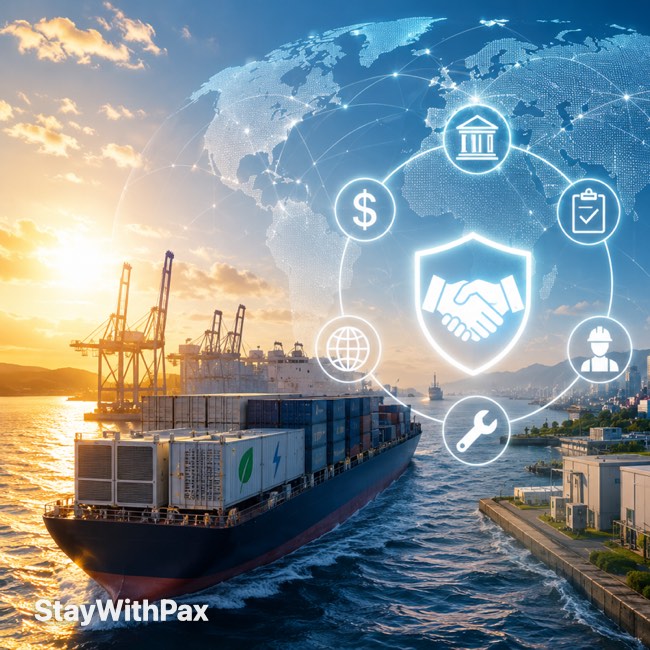
Products are the ship. Orders are the wind. Finance, compliance, service, and local delivery are the navigation system that decides whether the ship can travel far.
Every country has its own consumers, channels, taxes, payment habits, regulatory boundaries, and trust structure. A company cannot put its domestic model into a container, ship it overseas, and expect it to grow automatically.
Real operations begin after arrival: can the company stand firm, continue delivering, earn customer trust, and collect money?
Practical Takeaway
For Chinese cleantech companies, the next stage will not be decided only by product strength. It will also depend on who can bring product, capital, service, organization, and compliance together and rebuild them into a business that works locally.
That is a much higher requirement. It is also the real moat after overseas business lands.